Golf carts are widely used across North America, with different functional configurations tailored to diverse application scenarios. For golf course use, the rear can be fitted with a golf bag cover and storage basket. When used for neighborhood transportation, a rear-facing flip seat can be installed to add two extra passenger seats. For cargo transportation on farms or ranches, a rear cargo box can be mounted instead.
Vehicles in the G Series under GreenRider have been developed with various practical usage scenarios fully taken into account through modular design. This approach not only boosts factory production efficiency but also enables customers to carry out quick DIY retrofits. Take our G2 Series as an example:
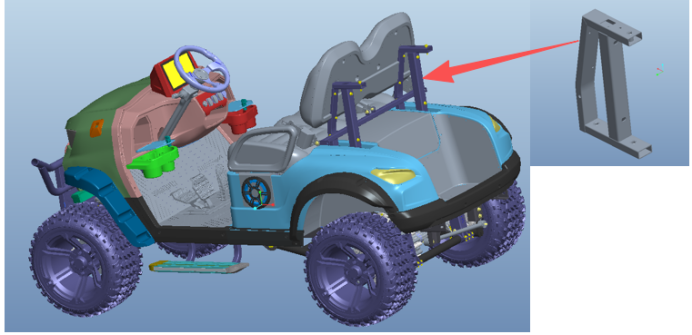
The universal components shared by all models of our G2 Series are shown in the figure on the left below:
The variations among our different models are mainly realized through the multi-functional backrest bracket (see the upper right picture), which serves as the core module for switching between various models.
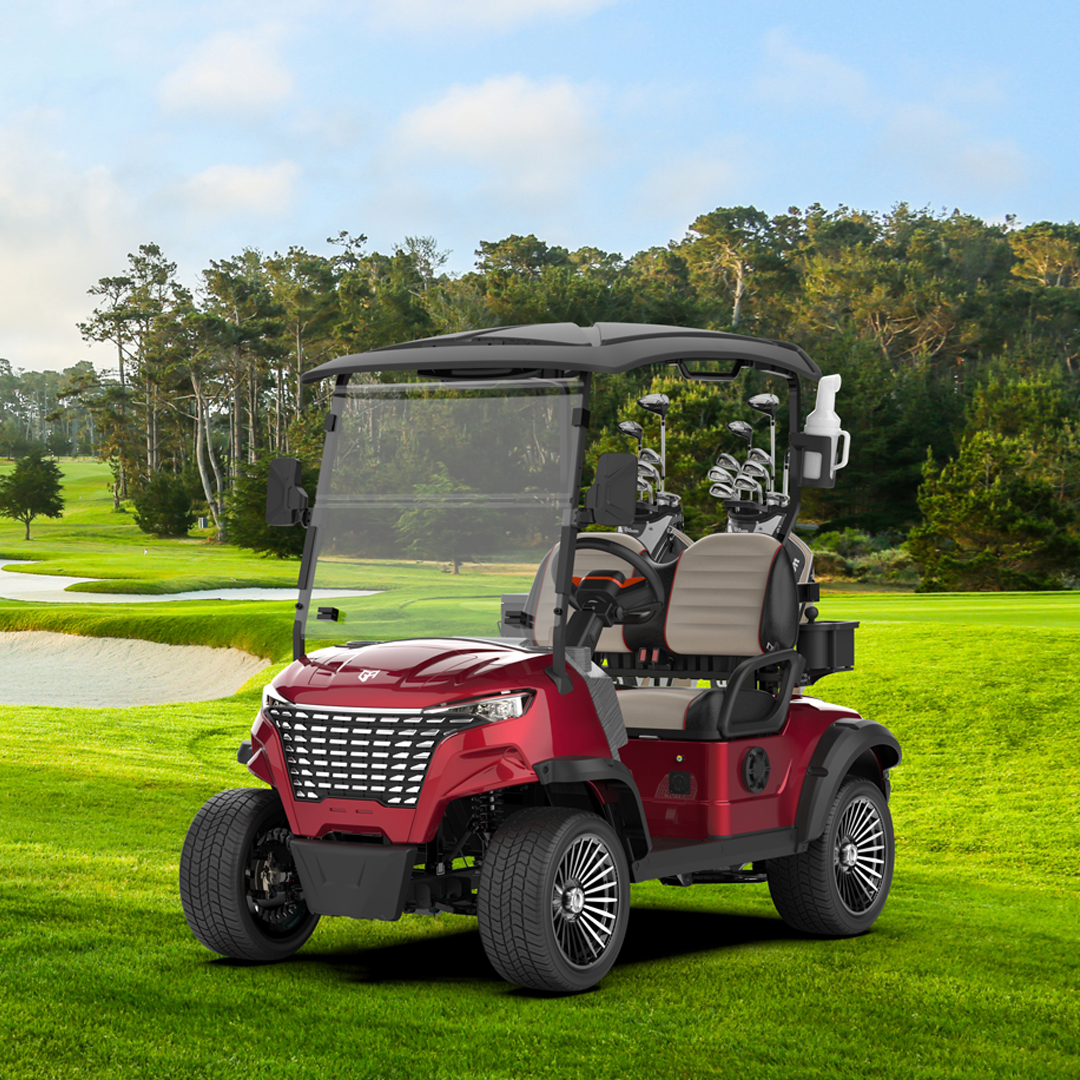
1.For golf course applications with Model G2, we first install the G2 roof and front windshield modules, secure the B-pillar onto the backrest bracket, then mount and fasten the storage basket and golf bag bracket module to the backrest bracket. A toolbox can also be fitted if required. At this point, the assembly of our G2 golf cart is finished, as shown in the picture below:
2.When used for short-distance transportation in residential communities, the model is G2+2. We install the roof and front windshield modules for the G2+2, then mount the rear-facing flip seat module via the backrest bracket. This completes the assembly of our 4-seater model for community commuting, as shown in the figure below:
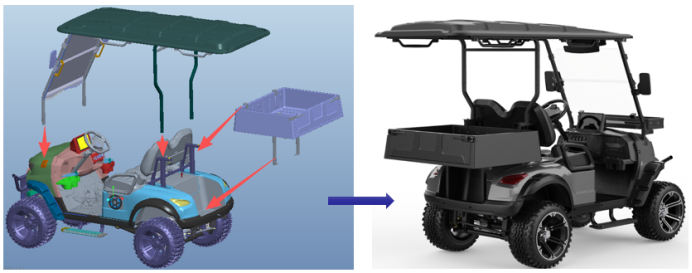
3.If the vehicle is used for cargo transportation on farms or ranches, the model is V2H. We usually first fit a heightening module to upgrade it into a high-clearance chassis (refer to our previous article: Golf Cart Modular Design Series (Part 1) — DIY Chassis Rapid Lift/Lower Module Design). After that, we install the roof and front windshield modules of the G2+2, followed by the cargo box module via the backrest bracket, forming an off-road cargo cart, as shown in the figure below:
In conclusion, modular design facilitates rapid vehicle iteration, improves production efficiency, and enables end users to carry out DIY modifications with greater convenience.
Introduction:Electric golf carts are no longer just a tool exclusive to golf courses; they have become the preferred transportation choice for more and more users. With increasing environmental awareness and technological advancements, electric golf carts are now showcasing unique advantages across various sectors. So, why are electric golf carts becoming the future trend? Body: Conclusion:Overall, […]
Introduction:As an eco-friendly and cost-effective transportation tool, electric golf carts are gaining popularity. However, how can you maintain and extend the lifespan of your electric golf cart? In this blog, we will share some simple and effective maintenance tips to help you ensure your cart stays in top condition for years to come. Body: Conclusion:By […]
Introduction:When buying a golf cart, many people find themselves debating between electric and gas-powered models. So, what’s the difference between electric and gas golf carts, and which one is better suited for your needs? In this blog, we will provide a detailed comparison to help you make the best decision. Body: Conclusion:Whether you choose an […]
Prohibition on Using Lead-Acid Chargers for Lithium BatteriesFor common 48V and 72V electrical systems, the full charge voltages of lead-acid and lithium batteries are different, and their charging logic is also not the same. Using the wrong type of charger may, at best, prevent the battery from reaching a full charge, and at worst, cause […]
Electromagnetic brakes are commonly found in mid-to-high-end electric golf carts, typically mounted on the rear end of the drive motor. Their primary role is to serve as a parking brake, and in some models, they also function as an emergency braking aid. The core design principle is: energize to release, de-energize to lock — the brake pads are […]
(Exterior A-level curved surface standard) For the exterior components such as the body, front face, side wings, and roof of a golf cart, the commonly used CAS modeling surface (conceptual A-level surface) in the automotive industry is used to construct the process. Taking Rhino, a mainstream industrial design modeling software, as an example. It is […]



.jpg)